

Beese Fulmer’s Fall Symposium: Looking Beyond Economic Headlines
When interest rates or inflation shift unexpectedly, markets can react quickly. But that doesn’t mean you have to.
At our annual Economic and Stock Market Symposium in September, Beese Fulmer’s investment team explained why it’s important to look behind the headlines before reacting. They shared their rational assessment of recent market developments, examining the data and what it may mean for investors. Here are five key insights from this year’s symposium.
1. Stock Valuations Have Eased, but Remain High
After reaching higher levels in recent years, the S&P 500’s forward price-to-earnings (P/E) ratio had declined to 19.1 as of Sept. 11, 2026. That made valuations more reasonable than they had been at recent peaks. The ratio was still above its 30-year average of 17.2, however.
A forward P/E ratio shows how much investors are paying for stocks relative to the earnings those companies are expected to generate. It helps put valuations in perspective, but it does not predict where stock prices will go next. The earnings outlook and the returns from other investments also influence how attractive those valuations may be.
Key takeaway: Lower valuations can improve the investment picture, but “less expensive than before” does not necessarily mean inexpensive.
2. Higher Treasury Yields Have Changed the Comparison
Investors also have more to weigh when comparing stocks with bonds. The symposium presentation showed that U.S. Treasury yields had risen across the yield curve since the end of 2025. For example, the 10-year Treasury yield was about 5% on Sept. 11, 2026, compared with roughly 4.2% at the end of 2025.
When yields rise, bonds may offer a more compelling alternative to stocks for some investors. Higher yields can also put pressure on stock valuations as investors reconsider how much they are willing to pay for future earnings. The appropriate balance still depends on an investor’s goals, time horizon and tolerance for risk.
Key takeaway: Consider a stock’s valuation alongside the returns and risks of other available investments.
3. The Inflation Headline Does Not Tell the Whole Story
Inflation is often summarized in a single number, but prices for goods and services don’t all rise or fall at the same rate. In August 2026, the headline Consumer Price Index rose 3.4% from a year earlier, while the measure excluding food and energy rose 2.4%. Energy prices contributed to the difference.
Both numbers are useful. Headline inflation reflects a broad range of goods and services consumers buy. The measure excluding food and energy can help show underlying price trends without some of the sharper swings in those categories. Looking at the components helps explain why the two readings differ.
Key takeaway: Before reacting to an inflation report, look at what drove the number and whether those pressures appear likely to persist.
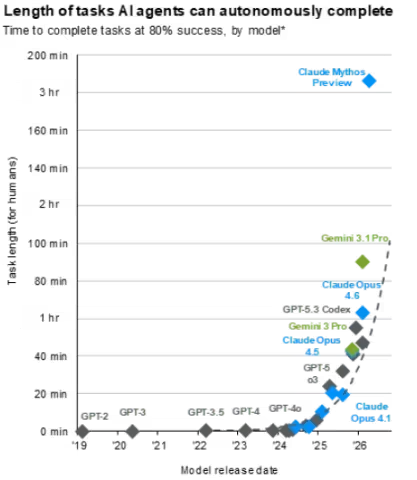
4. AI’s Potential Effect on Productivity Deserves Attention
We also examined AI's rapid evolution and how it will affect the workforce. The data showed that newer AI systems can successfully complete tasks that would take people increasingly longer to perform.
That progress raises important questions about how businesses may use these tools and whether their adoption will improve labor productivity over time. The chart measures AI capability, however, rather than economy-wide productivity gains. Businesses still must determine where the tools work reliably and how to integrate them into day-to-day operations.
Key takeaway: AI may influence long-term economic and business performance, but its investment implications require continued evaluation as real-world results emerge.
Looking Beyond the Headlines
These topics are connected. Higher bond yields can affect how investors value stocks. Inflation can influence interest rate expectations. Technological advances may eventually change the outlook for productivity and company earnings.
That is why our team examines new developments in the context of the broader market and each client’s long-term goals. The symposium gives us an opportunity to share that thinking with clients, discuss the questions behind the data, and continue the conversation as conditions change.
Want to discuss what today’s investment landscape means for your financial strategy? Start a conversation with Beese Fulmer.
Past performance is not indicative of future results. The material above has been provided for informational purposes only and is not intended as legal or investment advice or a recommendation of any particular security or strategy. The investment strategy and themes discussed herein may be unsuitable for investors depending on their specific investment objectives and financial situation. Information obtained from third-party sources is believed to be reliable though its accuracy is not guaranteed, Beese Fulmer Private Wealth Management ("Beese Fulmer") makes no representation or warranty as to the accuracy or completeness of the information, which should not be used as the basis of any investment decision. Information contained on third-party websites that Beese Fulmer may link to is not reviewed in their entirety for accuracy and Beese Fulmer assumes no liability for the information contained on these websites. Opinions expressed in this commentary reflect subjective judgments of the author based on conditions at the time of writing and are subject to change without notice. No part of this material may be reproduced in any form, or referred to in any other publication, without express written permission from Beese Fulmer. For more information about Beese Fulmer, including our Form ADV brochures, please visit https://adviserinfo.sec.gov and search for our firm name.